I thought the worst part of prom would be saying goodbye to high school. I had no idea that an unexpected moment would forever change the way I saw my father.
Prom was supposed to be the night everything would be perfect, but I spent most of it staring out the door. My name is Kelly, and for months I’d pretended I didn’t care if my dad showed up.
That was easier.
Easier than admitting that she still wanted him there, even after all the games she had missed, the dinners she had canceled, and the nights she heard him open the front door long after midnight.
Dad worked for a cleaning company that took care of schools and office buildings all over the county. He would leave before dawn and come home smelling of bleach, floor wax, and exhaustion.
Most days, our conversations barely lasted five minutes before turning into arguments.
“You missed my volleyball game again,” I told him one night.
She rubbed her tired eyes. “I know, Kel. I’m sorry.”
“You always feel it.”
“I do everything I can.”
“So why does it seem like work gets everything of yours and I get what’s left?”
He seemed hurt, but he didn’t argue. He never did. He simply lowered his head, nodded, and silently left for his next shift.
By the time the night of the dance arrived, I’d stopped asking him if he was coming. The gym was beautiful. The lights twinkled on the ceiling and the music vibrated off the walls.
The parents stood near the stage, taking pictures of their children as if they were proud to be there. Fathers in suits straightened crooked ties. Mothers adjusted dresses. Everyone seemed surrounded by family.
I stood next to my best friend Madison, trying not to look at the entrance.
“You keep looking at the door,” she said gently.
“No, I don’t.”
“Kelly”.
I swallowed hard. “He’s not coming.”
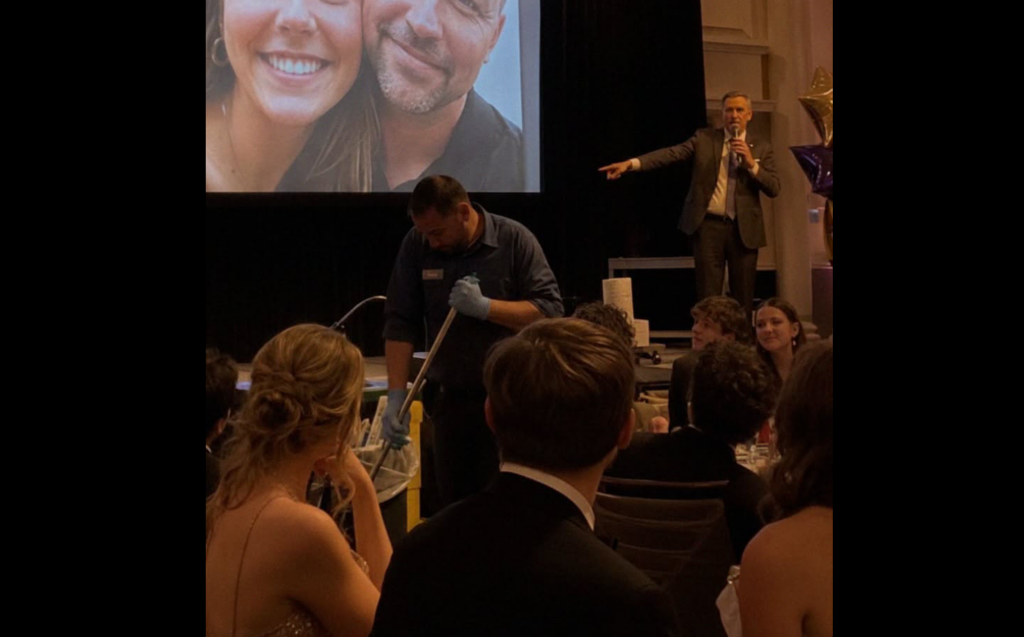
Before I could answer, the side doors opened. A cleaning crew entered, laden with mops, trash bags, and supply carts. At first, I barely noticed them. Then I saw the man in the middle of the group, wearing a dark blue uniform and worn work boots.
He was my father.
My stomach turned.
Across the room, her eyes met mine for a painful second before she looked away. Then the whispers began.
A boy near the back laughed loudly. “Kelly’s dad came to the dance with a mop.”
The heat rose to my face. My eyes burned, and I wished I could disappear. Then Principal Harris came up on stage and took the microphone.
“Well,” he said, looking at the cleaning crew, “this isn’t something you see every day.”
The room erupted in laughter.
And my heart stopped.
Laughter swept through the gym like a wave. Not everyone laughed, but enough people did that I felt every sound like a punch to the chest. I didn’t dare look at my father.
My face burned with humiliation, and for a horrible moment, I was angry with him again. Angry that he’d shown up dressed like that. Angry that he’d walked into my prom wearing the proof of everything I’d spent months trying not to think about.
I looked at the floor and prayed that Principal Harris would keep going.
Instead, she fell silent, and her laughter gradually faded. Then she looked directly at me.
“But Kelly,” she said gently, “you have no idea how lucky you are.”
The room became completely still.
I blinked.
For a second, I wasn’t even sure I’d heard her right. Principal Harris lowered the microphone slightly and smiled sadly.
“My father also worked for a cleaning company.”
Some students exchanged confused glances.
She continued, “He spent most of his life cleaning schools, office buildings, and hospitals. He worked nights, weekends, holidays, and every extra shift he could get because he wanted his children to have opportunities he never had.”
The gym was so quiet you could hear the hum of the ceiling lights.
Principal Harris took a slow breath. “And unlike your father…”
Her voice cracked slightly. “…mine never had the chance to attend my graduation.”
The words struck the room like thunder.
Nobody laughed.
No one whispered.
Nobody moved.
I saw her swallow hard before continuing. “My father died three months before I received my diploma.”
A painful silence fell over the crowd. For the first time, I noticed tears welling up in her eyes.
“She spent her whole life working so that I could build mine. And when I finally crossed that stage, the person who sacrificed the most for me to get there wasn’t in the audience.”
I got a lump in my throat.
Across the gym, I saw my father standing silently with his teammates. His shoulders were slightly hunched, and his hands were clasped in front of him, as if he wished he could disappear.
Suddenly, he seemed older than I remembered.
Much older.
Principal Harris turned to the cleaning crew. “People like them rarely get applause.”
Her voice grew louder. “While you’re dancing tonight, they’re taking out the trash. While you’re celebrating milestones, they’re cleaning the floors. While you’re sleeping, they’re preparing the buildings for tomorrow.”
He gestured gently to the workers. “The reason this gym looks so beautiful tonight is because people like them have spent hours transforming it into this.”
All eyes in the room followed his gesture. My father shifted uncomfortably.
She hated attracting attention.
I knew it.
However, for the first time I noticed things I’d never paid attention to before. The worn knees of his work pants. The faded company logo on his shirt. The weariness in his face. The calluses on his hands.
Signs of years of work. Years of sacrifice. Years dedicated to providing.
Principal Harris looked back at the students. “So before you laugh at someone’s work again, remember this.”
His voice echoed through the gymnasium. “Dignity doesn’t come from a suit.”
The room fell completely silent.
“It comes from sacrifice.”
Something inside me broke.
I thought about all the arguments I’d had with my father. Every time I’d accused him of caring more about work than me. Every birthday he’d come home exhausted. Every school event he’d missed because he was working overtime.
I had spent so much time focusing on his absence that I had never stopped to ask myself why he was absent. The answer was right in front of me. He wasn’t working because he didn’t care. He was working because he did care.
Tears blurred my vision.
Then something unexpected happened. A student started to applaud.
Then another one.
Then another one.
Within seconds, the entire gymnasium had risen to its feet. Applause echoed through the room.
Students. Parents. Teachers. Everyone.
I looked at my father and his eyes widened. For a moment, he seemed completely overwhelmed. Then his gaze met mine and neither of us spoke.
It wasn’t necessary.
Because, for the first time in months, I wasn’t looking at a janitor. I was looking at my father. And, suddenly, I had never felt prouder.
The applause lasted much longer than anyone expected.
What had begun as hesitant applause quickly grew into something that seemed to fill every corner of the gymnasium. The students who had been laughing moments before now had their heads bowed.
The parents wiped their eyes. The teachers exchanged excited glances. Even the cleaning staff seemed stunned by what was happening.
And in the middle of it all was my father.
He seemed completely overwhelmed.
His hands hung awkwardly at his sides, and his expression showed the same uncomfortable humility he always displayed when someone thanked him. My father had spent his entire life working behind the scenes.
Recognition was something that happened to other people. He was the man who stayed late after everyone else had gone home, the person who quietly fixed problems that no one noticed until they disappeared.
Seeing him receive a standing ovation seemed almost surreal to me.
Then I saw him do something that broke my heart. He looked toward the exit as if he intended to slip away.
As if she thought the attention belonged to someone else.
For years, I had convinced myself that my father preferred work to our family. I had spent countless nights sitting in the stands searching for his face and feeling disappointed when I didn’t find it.
I remembered the birthdays he was late to because of an emergency shift, the school events he missed completely, and the dinners that got cold while we waited for him to come home.
Each of those memories had fueled my resentment.
But now, standing there, listening to Principal Harris talk about sacrifice, I realized I’d only seen half the story. I remembered something my mother used to say whenever I complained.
“Your father doesn’t miss these moments because he wants to.”
At the time, I never listened to her; now I wish I had.
Suddenly, I no longer saw the father who missed volleyball games. I was seeing the man who worked 12-hour shifts so I could play volleyball in the first place.
The man who bought me my first computer. The man who somehow found money for prom tickets, even when I knew things were bad. The man who silently carried burdens I never bothered to ask about.
My chest tightened.
Before I knew what I was doing, I’d moved away from Madison and started walking. Then walking turned into running. The crowd parted as I crossed the gym floor.
People watched in silence. No one laughed. No one whispered.
When I arrived next to my father, tears were running down my face.
He looked surprised. “Kelly?”
She could barely speak.
For months, I had rehearsed arguments in my head. I had imagined confronting him for every disappointment, every wasted moment, every time I felt forgotten.
Now none of those speeches mattered.
“I’m sorry,” I whispered.
Her eyes widened. “What?”
I shook my head as the tears continued to fall. “I’m sorry.”
The words came more easily the second time. “I’m sorry I got angry. I’m sorry I didn’t understand you. I’m sorry for thinking you didn’t care.”
My father’s face wrinkled. For a moment he looked away, as if trying to hide his own emotions.
Then he pulled me into his arms. As soon as he did, something inside me finally broke. I hadn’t realized how much I missed him until that moment.
Not physically.
But emotionally.
I missed feeling connected to him. I missed believing he understood me. I missed seeing him as my hero. And then, suddenly, all of that came back.
“I never wanted you to think I didn’t care about you,” she said softly.
Her voice trembled. “I just wanted you to have a better life than mine.”
Those words hit me harder than anything Director Harris had ever said. Because they weren’t polished, they weren’t part of a speech.
They were simply the truth.
I looked down at his hands, which rested on my shoulders. The skin was rough from years of hard work. His knuckles showed old scars I’d never noticed before. His nails were stained from a job that never seemed to wash away completely.
Those hands had spent years building my future.
And somehow, I had only noticed the times they weren’t there.
“Do you know what hurts the most?” I asked gently.
Her expression was full of concern. “What?”
“That I was ashamed.”
The confession made me feel bad. “In fact, I was ashamed.”
My father looked at me for a few seconds and, to my surprise, smiled. Not because he found it funny. Because he understood.
“When I was your age,” she said quietly, “I was also ashamed of my father.”
I blinked. “What?”
He nodded. “I used to work in a factory. I used to wish I had an office job like everyone else’s dad.”
A sad laugh escaped him.
“It took me years to realize how much he worked for us.”
For the first time all night, I laughed through my tears. The tension between us began to dissolve. Years of frustration and misunderstanding seemed to loosen with every word.
Around us, the gym remained strangely quiet. People were looking at us, but it no longer seemed awkward.
It made sense.
Then Director Harris walked towards us with a camera.
“I believe this moment deserves to be remembered.”
The crowd immediately agreed.
Students and parents gathered around us as the teachers invited the cleaning crew to join the photo.
At first, my father resisted. He hated being the center of attention, but in the end, he gave in. When the camera flashed, I looked up at him. And for the first time in years, I saw something I hadn’t seen in a long time.
Pride.
Not pride in himself. Pride in me.
Years later, that photograph is still hanging in my house.
Whenever people visit me, they assume it’s a photo from the prom.
They are wrong.
It’s a photo from the night I finally understood what love is. Sometimes he wears a tuxedo. Sometimes he arrives laden with flowers. And sometimes he comes in through a side door in a cleaning uniform after working a 12-hour shift.
But true love isn’t measured by appearances; it’s measured by sacrifice. That night, while everyone else reminisced about the music, the decorations, and the dancing, I left with something far more valuable. I left knowing that the man I had shamed was the strongest person in the room.
And once I understood that, nobody’s laughter mattered anymore.
If you were Kelly, how would you have reacted when the students started laughing at your father?