My mother disappeared when I was seven years old. Twenty years later, she knocked on my door with a folder, a threat, and a demand that could destroy everything I had built.
Three slow knocks on the door.
I frowned as I looked at the clock. Almost nine o’clock.
I crossed the hallway barefoot and opened the door.
I recognized those eyes.
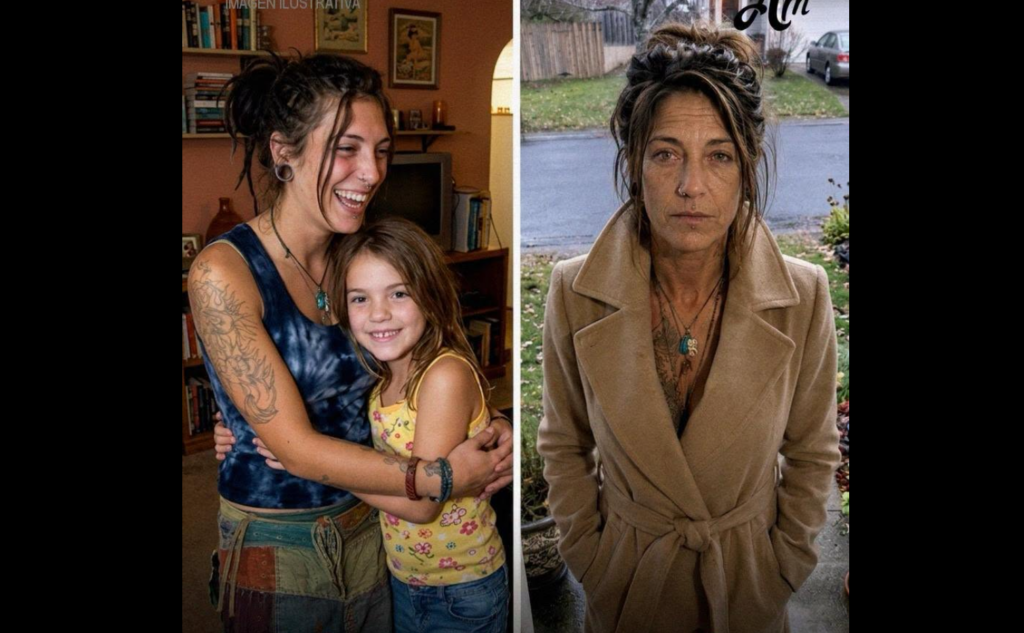
A woman stood on the porch, bathed in yellow light. Her gray hair was pulled back tightly. Deep wrinkles were etched around her mouth. Her nervous fingers gripped the strap of a purse that looked older than me.
“Can I help you?”
He didn’t answer. He just tilted his head, a small, quick movement, like a bird’s.
Something inside me fell silent.
He left.
I recognized that head movement. I recognized those eyes. I’d spent twenty years trying not to recognize them.
“Mother?”.
My voice sounded weaker than I wanted it to.
The last time I saw Diane, she was seven years old and sitting on a plastic chair in a police station, her backpack between her feet. She had told me to wait while she went to talk to someone.
“A foster girl builds an empire in her hometown.”
Then he left.
I waited until a social worker came to get me. Then came the foster homes. A spare room for three months. A sofa for six weeks. Another family, another school, another garbage bag full of all my things. By sixteen, I’d completely stopped unpacking.
Diane never returned.
At eighteen, I passed the age limit with $143 and two garbage bags full of clothes. I started selling handmade candles to survive. Last month, I opened my fifth shop.
An hour ago, I was drinking lavender tea in my kitchen, with the local newspaper open on the countertop.
“A foster girl builds an empire in her hometown.”
I had imagined that, in the end, I would return.
My phone vibrated. It was Megan , my best friend.
He’d sent me a message after reading the article: “Now you’re officially unbearable. Congratulations .” I laughed and told him I’d doubled the scholarship fund.
And then something ancient rose in my chest, as it always did on nights like this.
For years, I had imagined that, eventually, he would return. That he would appear at my door with an explanation good enough to make sense of what he had done.
No child in there will ever feel rejected.
I had stopped admitting it to myself long before I stopped having hope.
I picked up my cup of tea and reminded myself of the events.
Now he was twenty-seven. He had a home. He owned five stores. He had a plan for a mentoring program for kids who became homeless when they reached the age limit in foster care, and next month he was going to sign the papers.
At sixteen, alone in front of the bathroom mirror, I made a promise to myself: if I ever have a home of my own, no child living in it will ever feel rejected.
“I have an offer you can’t refuse.”
Now, Diane, the mother who had abandoned me, was standing on my porch.
Her left arm was tucked behind her back at an odd angle, as if she were hiding something she wasn’t ready to show me yet. She didn’t apologize. She didn’t cry. She didn’t say my name.
Diane looked me straight in the eyes, her mouth pressed into a firm, determined line.
“I have an offer you can’t refuse,” he said. “And before you tell me to leave, listen carefully.”
“I’ve brought newspaper clippings.”
I took a step back, moving away from the door, but I didn’t offer her a seat.
“Say what you came to say.”
Diane walked past me and into the lobby, slowly and purposefully, as if she had every right to do so. She pulled a manila folder and a small leather notebook from behind her back.
He left them on the small table in the entrance hall, like a lawyer presenting evidence.
“That’s a lie.”
“I’ve brought newspaper clippings,” she said. “You’ve been very busy.”
“You have thirty seconds.”
She smiled at that, with a faint, patient smile.
“I know why they’ve been moving you around, Claire. From foster family to foster family. Eleven years like this.”
“I’ve been transferred because the system transfers everyone.”
“I have never taken anything from anyone.”
“You were transferred because things kept disappearing.” She opened the notebook without looking at it. “Money from a purse. A pair of earrings. A watch that belonged to someone’s grandmother.”
“That’s a lie.”
“Then prove it.”
I felt my jaw tense up.
“I have never taken anything from anyone.”
“Journalists need a headline, not proof.”
“I believe you,” Diane said calmly. “But that’s not the point. The point is what a journalist will believe when a grieving mother sits before him with tears in her eyes.”
“You’re threatening to ruin my reputation with a story you know is a lie.”
He turned a page.
“The files are sealed. Half of those foster parents have died or left. A child who went through eleven homes fits the story. Journalists need a headline, affection, not proof.”
“I can cry in front of that gravestone.”
My stomach lurched. I put a hand on the entryway table and told myself: don’t argue with the facts. Let him keep talking. The more he says, the more proof you’ll have.
“Get out of my house.”
“I’ve already spoken to a journalist,” Diane said. “She’s ready to publish the story this week.”
My biological mother paused, looking me in the face.
“And I’ve been to the cemetery twice this month. One of your former foster mothers is buried there. Her daughter still swears that a pearl brooch disappeared while you were living in that house. I can cry at that gravestone on camera whenever the reporter wants.”
“How much?”.
I clenched my fist at my side and forced myself to exhale slowly. Think, Claire.
Diane hadn’t been to any of those foster homes. She didn’t know the families. She was bragging.
Which meant that he wouldn’t know that Megan had never been one of them.
Megan. My best friend. And, if Diane believed me, my former foster sister.
“You’ve made up a very nice story.”
“How much?” I asked.
He tapped a clipping in the folder: the headline about the scholarship fund, with my name circled in blue.
“That article said you’re going to double your fund next month. Ten thousand a month. For the rest of my life. You wouldn’t even notice.”
“You’re crazy.”
“I am your mother.”
“Please don’t do this.”
“You stopped being one in the police station hallway.”
She didn’t flinch. She wrote a number on a page of the notebook and slid it to me.
“You’ve spun a lovely tale, Claire. A foster child, candles on a folding table, five shops. It makes the front page. That’s why investors trust you. That’s why parents let you near the children in their charity. Pull on one thread of that story and it all starts to unravel.”
I let my hand tremble. I let my eyes fill with tears. I gave him exactly what he wanted to see.
“You’ve forgotten about Megan.”
“Please,” I whispered. “Please don’t do this.”
Something unpleasant crossed his face. Satisfaction. He had come here expecting a fight, and instead, I was already surrendering.
“Friday,” he said. “The first payment before Friday. Then we’ll talk about the schedule.”
I braced my palm against the wood to keep my balance. Then I looked up.
“You’ve forgotten about Megan.”
“You weren’t there.”
He frowned, just a little.
“Who?”.
“Megan. I lived with her family for a year when I was ten years old.”
“I don’t remember any Megan.”
“You wouldn’t remember. You weren’t there.”
“Please follow me.”
I let out a shaky sigh. “She knows you were never robbed. I’m going to see her right now. As soon as she speaks, no journalist will dare touch your story.”
Something in Diane’s gaze quickly calculated.
“You’re placing a lot of trust in just one woman,” he said.
“After that,” I said, in a lower voice, “your story will be worthless.”
“We’ll see.”
He picked up his folder and left the way he had come in.
“Come in.”
I watched her from the window as her old sedan sat parked on the sidewalk, engine idling and headlights off. Waiting.
I grabbed my keys and my coat.
“Follow me,” I whispered against the glass. “Please, follow me.”
Diane’s headlights stayed three car lengths behind me the entire way to Megan’s house.
“He parked at the end of the block.”
****
I parked in front of Megan’s house and pretended to look at the number above the porch, making sure Diane saw it too.
Megan opened the door before I could knock.
“Come in.”
I hugged her on the porch long enough for Diane to see, and then I followed her inside.
“It’s parked at the end of the block,” I whispered to him.
“He’ll have to deal with me.”
I told him about my biological mother, the story of the robbery, and the ten thousand a month.
When I finished, Megan took out her mobile phone.
“Okay. We’re going to destroy it.”
“He’ll say I set a trap for him.”
“Well, you won’t be there. He’s followed you here. If he comes back to check if I’m real, he’ll have to deal with me.”
Diane had to make the proposal herself.
I looked at her.
“Would you do that?”
“Claire. You’re my best friend. To me, you’re like family.”
We spent the next hour going over one rule: Megan would not offer, suggest, or give any hints. Diane had to make the proposal herself.
“I am Claire’s mother.”
****
The next morning, at nine ten, Diane knocked on Megan’s door.
I was already in the back bedroom, sitting on the edge of the bed, with my mobile phone flashing green on the nightstand, behind the half-open door.
“Can I help you?” Megan asked in a cautious and polite voice.
“Are you Megan?” My mother’s voice chilled me to the bone. “I’m Claire’s mother. I understand you met her a long time ago.”
“Can I come in?”
“Yes. Claire came over last night. She told me about the accusations.”
A pause.
“So now you know why I’m here.”
“I suppose you want to ask me about the things that, you say, have disappeared.”
Another pause. This one longer.
“I would say that to any journalist who asked me.”
“Can I come in?”
Footsteps are heard. The soft sound of the door closing.
“Claire says that nothing was ever stolen from her while she lived with your family.”
“You’re right.”
“Did anything ever disappear?”
“Ten thousand dollars for an interview.”
“Nothing. I already told Claire that I would say that to any journalist who asked me.”
Silence fell over the entire house.
“You seem very confident.”
“I am.”
“Perhaps you should think twice before talking to anyone.”
“What would you like me to say?”
“Because?”.
Diane sighed. “What if your time was worth something?”
“What do you mean?”.
“Ten thousand dollars for an interview.”
A pause.
“Would you pay me twenty thousand?”
“What would you like me to tell you?”
“Things disappeared while Claire lived there.”
“But they didn’t disappear.”
“Twenty thousand.”
The silence that followed made my heart pound in my ears.
“Okay. I’ll do it.”
“If even one person contradicts Claire’s version, people will start asking questions.”
“Twenty thousand?”
“Yeah”.
A pause.
“Okay. I’ll do it.”
“She’s willing to ruin me for money.”
Diane’s voice softened. “Good. Then maybe Claire will decide that ten thousand a month is cheaper than losing everything.”
I heard my mother’s chair being scraped backward. The front door opened and closed.
****
Megan waited a moment before saying my name.
I left the bedroom. I had my phone in my hand, the green light still flashing.
“I’m not going to pay you anything.”
“She didn’t care if I had stolen anything,” I said. “She came back after twenty years, ready to destroy me for money.”
For a second, I was seven years old again, watching a red coat disappear down the hallway.
Then I dried my face.
“We have it.”
I picked up my phone and texted Diane: “I’m not going to pay you anything. Do whatever you want . “
“It’s a lie.”
His response came within minutes.
“You chose it yourself.”
****
The following morning, a local gossip website published the story. The article was based on the tearful testimony of a mother and an anonymous foster sister who had “agreed to corroborate it within a week”; Diane had used an unnamed witness, keeping her alleged collaborator safe and out of the picture.
Marcus was the first to call.
“You’re going to be suspended from the scholarship committee.”
“Claire, what awaits me?”
“A lie. Give me until tomorrow.”
Silence.
“Claire, the board met twenty minutes ago.”
I gripped the phone tighter.
“Staying tied to this could harm the children.”
“AND?”.
“You will be suspended from the scholarship committee until this is resolved.”
For a second, I was speechless.
“Marcus, that program exists because I created it.”
“I know”.
“Then you know perfectly well what they intend to achieve with this accusation.”
“Yes. But right now, they believe that keeping you involved could harm the children we’re supposed to be helping.”
That one really resonated with me.
Not the shops. Not the investors. The children.
First payment before Friday.
“When does the suspension come into effect?”
“It has already come into effect.”
Then my phone vibrated again.
Diane: Ten thousand. The first payment is due before Friday. After that, I’ll say I made a mistake.
I read it twice.
I jumped in without notes.
I had no idea what Megan had recorded. Good.
But, for the first time since he walked onto my porch, I understood what it was going to cost me to wait.
I forwarded the message and the recording to my lawyer. By the afternoon, my team was already organizing a press conference at the flagship store.
****
The following afternoon, I held a press conference at my flagship store. Journalists filled the aisles between the candle displays, cameras pointed at the podium. I stepped onto the podium without notes.
I pressed “play”.
“Yesterday, my biological mother accused me of stealing from the foster families who raised me. These accusations have cost me my position on the scholarship committee that I helped create.”
I let it sink in.
“Are you saying he lied?” someone shouted from the crowd.
I looked towards where the voice was coming from.
“I could stay here and ask you to believe me. But instead, I’d rather you listen to what she said when she thought I wasn’t listening.”
“Why didn’t you post it yesterday?”
I pressed “play”.
Diane’s voice filled the store, offering Megan twenty thousand dollars to back up a story she knew wasn’t true. Then came the part about my money. What I owed her. What would happen if I refused to pay.
By the time the recording was finished, nobody was taking notes anymore.
A journalist in the front row raised his hand.
All hands went up.
“Why didn’t you post this yesterday, before the news broke?”
“Because I didn’t want another accusation,” I said. “I wanted proof.”
“And you let the news get published?”
“For one day.” I looked through the cameras. “She spent twenty years believing that fear would make the decisions for me. I needed her to believe it one more time.”
For a moment, there was silence in the room.
“You’re back on the scholarship committee.”
Then all hands were raised.
****
By nightfall, the gossip website had already retracted the story, and Marcus called me.
“The board has voted again. Unanimously. You are back on the scholarship committee.”
A few weeks later, I was sitting on Megan’s porch watching the kids in my mentoring program plant marigolds.
There are families you are born into.
“Are you okay?” Megan asked me.
I thought about all the years I had spent waiting for my mother to come back and fix everything.
“Yes, I’ve finally realized that I don’t need her for that.”
One of the children called me by my name.
I put down my tea and went over to them.
There are families you’re born into. Others are the ones you choose… and the ones you build yourself.