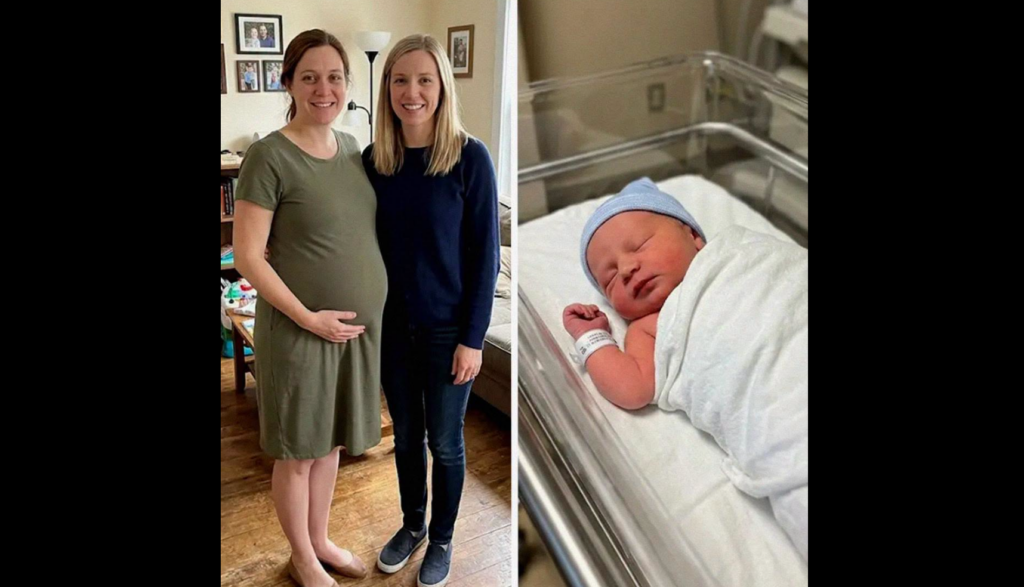
I volunteered to be a surrogate and carried my best friend’s baby for nine months. The moment her baby was born, she looked at him and said, “I can’t take him.” I was stunned. I gave her a child. She gave me a truth I wasn’t ready to hear.
When my best friend, Rachel, told me she couldn’t carry a pregnancy to term, I was the one who said it first: “Let me do it. Let me carry your baby.”
Carrying a baby in my womb for the third time felt like a strange and fragile wonder. Rachel came to every ultrasound, held my hand, and called her baby our miracle even before it had a name.
“Let me take your baby.”
I vomited for almost my entire pregnancy. My mother and my two sons were the ones who held my hair back and kept the house running while I worked.
Twenty-one hours. That’s how long the labor lasted. Each of those hours had the kind of pain that makes you negotiate with things you don’t even believe in.
By the time they placed him in the nurse’s arms and he let out that first furious cry, I had nothing left. Not words. Not tears. Only the hollow relief of a body that had finally finished doing the most enormous thing it had ever been asked to do.
Twenty-one hours. That’s how long the delivery lasted.
Rachel was by my side the whole time, holding my hand so tightly that my fingers had gone numb by about the 14th hour.
The nurse cleaned the baby and wrapped him in a white blanket. Rachel took a trembling step forward, her eyes already moist, reaching out her hand. And then she stopped.
The nurse had moved the blanket to check the baby’s legs, and there it was: a dark birthmark running up the top of his thigh, about the size and shape of a thumb pressed against the skin.
Rachel’s face contorted so much that I got scared.
“No,” she whispered.
Rachel’s face contorted so much that I got scared.
“It’s just a birthmark,” the nurse said gently, still smiling. “Very common.”
Rachel took a step back. She put her hand to her mouth.
“I can’t take it with me.”
The room fell silent. Her husband, Marcus, looked at her from across the room, his expression shifting from confusion to something else entirely—something that looked very much like fear.
“Rachel,” he said. “What are you doing?”
“It’s just a birthmark.”
She didn’t answer him. She pointed to the birthmark. And then she said, in a voice he had never heard from her in fifteen years of friendship: “That’s not possible. I’ve seen that same mark before… years ago, when Daniel used to run with you in the summer, both of you in shorts.”
I didn’t know what that meant. But Marcus did.
I was still trembling. My body was raw, the blanket around my shoulders did nothing, and I watched as my best friend crumbled before my eyes without understanding a single reason.
Marcus had turned the color of old concrete. He was no longer confused. He was terrified.
I didn’t know what that meant.
Rachel immediately picked up her phone and made a call.
“Put your wife on the phone,” he said. “She deserves to see this.”
Almost 30 minutes later, a young couple ran through the door of the room.
Rachel turned against them as soon as they entered.
“How could you?” she demanded, her voice cracking at every seam. “It’s your baby, Daniel. I’ve seen that same mark before, the summer you and Marcus were running around in shorts. You’re the only one who has it.”
The man, Daniel, opened his mouth. But nothing came out.
A young couple ran through the living room door.
“Birthmarks like that can be hereditary,” the nurse added carefully. “But a test would be needed to confirm anything.”
“No proof is needed,” Marcus said too quickly. He ran a hand over his face, already shaking his head. “I’ll tell you the truth.”
His confession came out like something that had been stuck between his teeth for years.
“I had a vasectomy,” he admitted, looking at Rachel. “Before we even talked about having kids. When you mentioned IVF, I panicked. I didn’t tell you. I used my brother Daniel’s sample instead of mine. I figured it wouldn’t matter. It was still your egg. I told the clinic we were using a previously stored donor sample. I took care of the paperwork. You never saw the consent forms.”
“I thought it wouldn’t matter.”
The silence that followed was the loudest I have ever heard in a hospital room.
Rachel let out a sound that wasn’t a laugh or a sob, but that lived somewhere in the terrible space between them. “You let me believe this baby was ours,” she spat. “For nine months, you let me believe…”
“I donated it,” Daniel interrupted, his voice both defensive and cracking. “He told me you had agreed. He said it was a family decision.”
Claire, Daniel’s wife, stared at her husband as if she were seeing a stranger’s face where a familiar one had once been. “Did you donate your sperm?” she whispered.
“You let me believe that this baby was ours.”
“She said she knew,” Daniel repeated, but this time with less conviction.
Rachel looked at the baby again, and for a split second I saw… not disgust. Betrayal. Every ultrasound. Every whispered name. Every future I’d imagined crumbling in real time.
She shook her head slowly. “I can’t raise a baby shaped like a lie. Every time I look at him, I’ll see exactly what you did.”
She left the room. I called her twice. The door closed behind her.
“I can’t raise a baby who is shaped like a lie.”
I turned on Marcus. “You let me carry this baby for nine months without telling either of us the truth?”
“I’ll fix it,” he said weakly. “I’ll fix everything.”
Then he left too. Daniel and Claire followed him, arguing heatedly in whispers down the corridor.
And I was left alone in that hospital bed with a newborn in my arms, a baby that no one had claimed, and a question that kept going around in my head: If they don’t take him, who will?
The legal paperwork for the adoption wasn’t finalized yet. On paper, the baby was still mine.
She was alone in that hospital bed with a newborn in her arms, a baby that no one had claimed.
***
I was discharged three days later.
My mother was already living with us, helping with my children, Mia and Caleb, while I worked. That afternoon she stood in the doorway with both of them in her arms, looking at the baby I was holding with that particular expression she reserved for moments when she was right but didn’t want to say so.
“You were barely hanging on,” he muttered. “And now this.”
“I’ve been wearing it for nine months, Mom,” I said. “It’s not disposable just because the adults made a mess.”
He shook his head, but stayed. He got up at three in the morning when I couldn’t move and didn’t say another word, which was a form of love.
“It’s not disposable just because adults have made a mess.”
Rachel didn’t call. She didn’t text. Marcus did. He sent diapers, milk, and a box of baby clothes still in its packaging. Everything arrived in cardboard boxes on my porch, like guilt disguised as logistics.
One night, maybe a week later, I was rocking the baby in the dark at 2 a.m., and I said it out loud to the empty room.
“Justin”.
It was the name Rachel had chosen at the 20-week ultrasound. “Justin,” she had whispered, her hand resting on my belly. She was so sure, so full of joy.
The name still fit him, that small, serious, warm-breathed person who had no idea of the disaster into which he had been born.
Rachel didn’t call. She didn’t send any messages.
Mia and Caleb had started calling Justin little brother after three days, and I had given up trying to correct them.
I found out through mutual friends that Rachel had returned to work.
I didn’t offer him my hand. I didn’t know how, and I already had enough on my plate with two kids, Justin, and the job I’d gone back to on reduced hours.
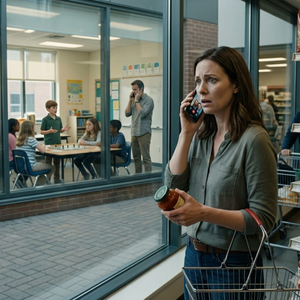
One afternoon, I rushed to the supermarket for milk, with Justin strapped to my chest in the baby carrier. I turned down the baby aisle and found Rachel standing there.
She stared at a row of cans of infant formula as if she had been asked a question she didn’t know how to answer.
Mia and Caleb had started calling Justin little brother.
I didn’t announce myself. I didn’t say his name. I just walked by, adjusting Justin in the baby carrier, and he made that little noise he always made when he was happy.
A woman who was browsing nearby looked at me and smiled. “It’s absolutely beautiful.”
“Thank you,” I said.
Rachel slowly looked up.
First she saw Justin’s face. Then, the way he had snuggled up to me, his fingers curled in the fabric of my shirt, completely at ease, the way only newborns feel when they fully trust the person holding them.
Rachel’s eyes welled up before she could stop them. But she turned her cart around and headed to the other end of the aisle without a word.
Rachel’s eyes filled with tears before she could stop them.
Two weeks later, I made a decision.
Waiting wasn’t working. The silence was only getting harder, and Justin deserved to have his name spoken in front of the people who loved him, not just whispered to him in the dark.
I texted Rachel: “We’re officially naming him Justin on Saturday. I thought you should know. You don’t have to come.”
There was no response.
I organized a small gathering at my house: my mother, a couple of close friends, and my neighbor, who had brought food for three weeks straight. Nothing elaborate. Just people who happened to be showing up.
Waiting wasn’t working.
Marcus arrived. So did Daniel and Claire, who seemed to have been arguing for two weeks and had reached a fragile ceasefire.
Rachel, they told me quietly at the door, wasn’t coming.
I nodded and went to pick Justin up from the bassinet, and he immediately grabbed my finger, as he always did, which still bothered me every time.
That’s when the doorbell rang.
Everyone in the room remained motionless in that particular way that people do when they have been collectively waiting for something they didn’t want to say out loud.
I opened the door.
They had been arguing for two weeks.
Rachel stood on the porch. She looked thinner. Tired in a way that sleep wouldn’t fix. But her eyes were clear, and she stood tall.
He had come. That was what mattered.
“I wasn’t ready before,” she said. “I’m not sure I am now. But I’m here.”
I took a step back and let her in without saying a word.
She walked slowly across the room, and people moved away from her, as they do when they sense a special moment and don’t want to interrupt it. Marcus watched her from across the room. She didn’t look at him.
She looked at Justin.
“I wasn’t ready before. I’m not sure I am now. But I’m here.”
I approached her and handed it to her, and she took it like you take something you’ve been trying not to want, carefully, as if she half expected it to hurt.
Justin fell silent as soon as he was in Rachel’s arms. He stopped complaining, turned his face toward her collarbone, and simply remained still, as he did when he recognized something.
Rachel’s breath caught in her throat as she exhaled. “He knows my voice,” she whispered. “I talk to him every week. He knows me.”
“She knows me,” I said.
She pulled him closer, pressed her face against his hair, and cried in a way he hadn’t seen her cry since her first abortion, three years ago, in her kitchen.
“He knows me.”
The betrayal was still there. The anger too. But there was something else besides it.
She had looked at that baby and finally understood that it wasn’t a lie. He was just a child. And she already knew his voice.
“I named him Justin,” I said softly. “Like you said at the ultrasound. You were so sure.”
Rachel nodded without lifting her head. “It fits,” she managed to say.
And it fit.
***
Three days later, I showed up at his door with Mia, Caleb, and a teddy bear that Caleb had insisted on bringing because, in his words, “Justin needs a friend.”
The betrayal was still there.
Rachel responded, wrapping her arms around his shoulder. Seeing him like that, that particular ease, as if she’d already made up her mind, loosened something in my chest that I hadn’t realized was still tight.
“Come in,” he said softly.
Mia and Caleb walked past her immediately, heading into the living room with the comfortable confidence of children who have already been welcomed somewhere.
Rachel and I stood for a moment in the doorway. Justin was standing between us in the most literal way.
I saw it cross her face: gratitude, apology, and the complicated love forged by something that could have broken a weaker friendship.
Justin was among us in the most literal sense.
“Thank you,” Rachel whispered. “For not giving up on him. Or on me.”
“You showed up, Rachel. That’s the part that mattered.”
***
Marcus and Rachel were in therapy. So were Daniel and Claire. Nothing was resolved.
But Justin was in his mother’s arms. Mia and Caleb were raiding Rachel’s refrigerator in the background. And my best friend was looking at the baby the way she’d looked at the ultrasounds, like it was something she’d been waiting for.
Justin was never the traitor. It was just the truth that no one had had the courage to face until a two-kilo baby with a birthmark on his thigh made it impossible to look away.
That day, secrets almost destroyed three families. A baby brought them back together, fist to fist.
That day, secrets almost destroyed three families.