I bought a new dress for our 40th wedding anniversary because I wanted to look beautiful for my husband. An hour later, he introduced his mistress to fifty guests and announced he was leaving me. Then my daughter took the microphone from her father. And the evening was no longer his affair.
David asked for the microphone at our 40th anniversary dinner and, for a brief, silly second, I thought he was going to surprise me with something nice.
He was about to give me a surprise. But it wasn’t anything nice, not at all.
I thought he was going to give me a nice surprise.
***
We had been together since college.
Forty years, three children, five grandchildren, a house we had painted twice and a garden we argued about every spring without ever changing its layout.
I still remembered the apartment where we started, the one with the radiator that rumbled like a drum all winter and the window that never closed completely.
And what about that year when David lost his first job? We ate beans and rice for two months and somehow we laughed more than we cried.
We had been together since college.
Forty years accumulate a lot of small, concrete things whose weight no one else would understand.
When David suggested a big celebration for our anniversary, I was thrilled.
He had never been one of the sentimental types, to be honest.
So when he booked a table at a fancy restaurant and started talking about inviting all our acquaintances, I allowed myself to believe that something about him had mellowed with age.
I got emotional.
***
“It’s a very special occasion,” she told me, taking my hand across the kitchen table. “I want everything to be perfect.”
I spent more time than I’m going to admit choosing a dress. I bought myself some new heels that I probably didn’t need.
I wanted to look beautiful for him, like I did at 22. Like that silly part of you that never stops loving him, even after four decades of marriage have taught you otherwise.
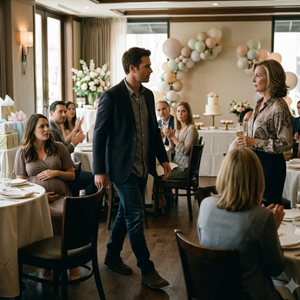
More than fifty people came. Our children. Our grandchildren. Old friends from three different decades of our life together.
“It’s such a special occasion.”
Everyone hugged us, congratulated us, and told us we were an inspiration.
I believed every word.
We had just sat down to eat when David stood up and asked the host for a microphone.
***
“Dear guests,” she said, and the room fell silent in that warm, expectant way rooms do when they think they’re about to hear something special. “I have important news, and it’s time everyone knew the truth.”
I believed every word.
I clasped my hands under the table, truly thinking that he had prepared some kind of surprise for me.
And so it was.
But not the kind I would never have imagined having in front of me in a room full of people who loved us.
He walked to the restaurant entrance, opened the door, and led a young woman inside by the hand. She looked to be about 35. Dark hair, a green dress—that kind of natural beauty that exists mainly because nothing has yet tarnished it.
“This is Lydia,” David said, smiling like a man unveiling a gift he’s proud of. “My true love.”
A great silence fell over the room.
He looked to be about 35 years old.
“On this very special day,” he continued, “I would like to announce that I am divorcing my wife and introducing Lydia to all my family and friends.”
I didn’t move. I don’t think I could have, even if I had tried.
Forty years.
Had I really been so blind all this time?
In the room there was an exclamation, and in the middle of that exclamation I heard the scraping of a chair, a glass being knocked over, and a child asking too loudly what was happening.
“I’m going to divorce my wife.”
My daughter, Claire, was sitting next to me. She put her hand on top of mine and squeezed it once, firmly.
“Mom,” she whispered. “Please don’t worry. I’ll take care of this.”
I didn’t understand what he meant. I barely understood anything at that moment, sitting there in my new dress with my heart lying on the floor, under the table.
Claire got up.
She approached her father with a serenity that had nothing to do with what I felt, and gently took the microphone from his hand.
I didn’t understand what that meant.
“Oh, Dad,” she said, her voice ringing clearly in the quiet restaurant. “I’m so happy for you. In fact, I have something for you too.”
She reached into her bag and pulled out an envelope.
***
“Please open it right now,” he said, handing it to her. “Consider it my gift to you and Lydia.”
David, still intoxicated by the euphoria of his own announcement, gave a mocking smile as he took it. I think that, at that moment, he thought that whatever was inside was meant to embarrass him. A document. A threat. Something sharp.
“Consider it my gift to you and Lydia.”
He opened it.
It wasn’t something sharp.
There were forty handwritten pages, each numbered in Claire’s careful handwriting, each with a single year written next to it.
He glanced at the first page and I saw his expression change.
“Third year,” Claire said, watching him read. “Mom worked night shifts in the hospital cafeteria so you could finish your postgraduate studies. You’d come home and ask why dinner wasn’t ready. You don’t remember that, do you?”
He opened it.
David’s hand was trembling slightly.
“Year eight,” Claire continued, not looking at her notes, because it was clear she didn’t need them. “You had spinal surgery. Mom spent three nights in a row sitting in a hospital chair. She didn’t go home once. She told everyone you were fine so no one would worry, including you.”
The room was completely silent, except for his voice.
David’s hand was trembling.
“Senior year of high school,” she said. “Your mother’s funeral. Mom drove four hours to be there with you. She had pneumonia all week and didn’t tell anyone, because she didn’t want anything about that day to revolve around her.”
David’s eyes were now fixed on the pages, turning them slowly, and I could see something on his face that I hadn’t seen in years.
Recognition, perhaps. Or the beginning of it.
I noticed something moving on her face.
“Year 27,” Claire said. “Your business almost went bankrupt. Mom sold the jewelry her own mother had left her. You never asked where the money came from. You just assumed everything was sorted out.”
A woman at the back of the room was crying uncontrollably. I heard someone else muttering something I couldn’t understand.
Claire let the silence linger for a moment.
“There are 36 other pages like that one,” he said. “Each year. Things you’ve forgotten. Things she never mentioned, because she didn’t keep track.”
“You just took it for granted that everything would turn out alright.”
David turned to the last page.
I watched her face as I read it, because a part of me needed to see exactly how it affected her.
There was only one line.
“This was the year you stopped choosing her.”
David stood there, holding forty years of his own life in his hands, and, for the first time since he had walked through that door with Lydia, it seemed that he really didn’t know what to say.
There was only one line.
“No,” she finally said, her voice breaking. “Please. Stop. You can’t do this to me.”
Claire didn’t raise her voice. She didn’t resort to cruelty, although I think everyone in that room would have forgiven her.
“You can leave if that’s what you’ve already decided,” he said. “But don’t rewrite history as you walk out the door.”
The room was so quiet you could hear the air conditioning.
“You can’t do this to me.”
***
Lydia, standing near the entrance and still in her green dress, seemed to wish she were anywhere else in the world.
Nothing else happened in that restaurant. No shouting. No dramatic scenes.
Claire put down the microphone, took my arm and escorted me to her car while the guests remained seated in a silence that none of them seemed to know how to break.
The guests remained silent.
***
We sat there for a minute after the doors closed.
“Mom, I’m sorry,” he whispered. “For the envelope. For tonight. For not telling you sooner.”
I looked at her and waited.
“I started suspecting Dad was seeing someone months ago,” she added. “Not because of anything specific. Just because of little things that didn’t add up anymore.”
“I started to suspect that Dad was seeing someone.”
Claire rubbed her eyes.
“I started collecting those memories because I wanted him to remember what he was moving away from. I thought that maybe, if he saw it all in one place, he would think twice before doing something he would regret.”
Her laughter was faint and tired.
“I never imagined I would end up giving it to her at their anniversary dinner.”
We remained silent for a moment.
“I started to collect those memories.”
Then he leaned over the console and took my hand.
“I couldn’t stop her from leaving, Mom. But I wasn’t going to let her rewrite history.”
That’s when I started crying again.
Not because my marriage was ending.
But because my daughter perfectly understood what she had missed out on.
I started to cry.
***
The weeks that followed were, in some ways, a blur and, in others, painfully clear.
He spent his days carefully, like when you move around a house after an earthquake, checking each room before deciding if it was safe to be there.
Friends called me, more than I expected, some I hadn’t heard from in years. A few sent me flowers with notes that made me cry more than the divorce itself.
Some sent me flowers with notes.
I met up again for coffee with my old friend Marjorie, something I had neglected for years without realizing how much I missed it.
I spent entire afternoons with my grandchildren, doing nothing in particular, building towers with blocks and listening to stories about school that didn’t lead anywhere in particular, and I discovered that doing nothing in particular was just what I needed.
Claire would come to see me every day, sometimes just with a message, other times bringing takeaway food with no other plan than to sit with me.
Doing nothing in particular was exactly what I needed.
I never asked her where she got the strength to stand up for herself in that restaurant. Some daughters just have it in them, I think, and you don’t always know it until the moment demands it.
David packed up his things in less than a month. He and Lydia found an apartment together. From what our children told me, he seemed, for a while, genuinely happy, in that way people are happy when they’ve just entered into a story they’ve been imagining for a long time.
I didn’t ask for details. I didn’t want them.
David took his things in less than a month.
A few weeks after leaving, David returned home to collect the rest of his belongings.
I wasn’t there. Claire told me about it later, little by little.
She checked the closets, the garage, the boxes in the attic, and what she found was nothing spectacular. Just the everyday remnants of a 40-year marriage.
Photo albums with worn corners from being handled so much. Birthday cards written in my handwriting, in his, and in the clumsy print handwriting of our elementary school children.
He checked the closets.
A shoebox full of movie ticket stubs that neither of us quite remembered. Our daughter’s elementary school crafts, still taped to the cardboard, on which you could still read, written in crayon, that Mommy and Daddy are the best.
On the kitchen table, right where Claire had left it, was the restaurant envelope.
I hadn’t finished reading it that night. Claire told me later that she suspected I wouldn’t.
This time, alone in the house we had built together, he read every single page.
Mommy and Daddy are the best.
I don’t know exactly how that affected him, because I wasn’t there to see it, and there are things a person has to feel in private before they can say them out loud to anyone else.
What I do know is that his relationship with Lydia did not survive the following winter.
***
I don’t think Lydia was a villain.
She was young, and David had shown her the version of himself that seemed easier to love. Dinners. Weekend getaways. No mortgage stories, no doctor’s appointments, and no 40 years of asking her for anything.
I don’t think Lydia was a villain.
For a time, perhaps he too believed that was what he was.
But real life demands more than that. It wants to know who’s there for you in the tough times, who remembers your mother’s name, and who sits in waiting rooms without being asked.
Seven months after the anniversary dinner, David came to see me.
He didn’t apologize. He just sat across from me at the kitchen table and said, “I thought I was leaving a marriage. What I was really leaving was a life.”
I let that sink in.
He didn’t apologize to me.
“That’s not the same thing,” I told him.
There was no reconciliation. Some stories don’t end with a ring being placed back on a finger. Some end with the two people finally coming to terms with what really happened.
What we have now is less than a marriage and more than nothing. Sometimes we sit on the porch and talk about the grandchildren. Sometimes we talk about the years that fill those 40 pages.
Some stories don’t end with a ring being put back on a finger.
He once thanked Claire for the envelope.
Not because of the restaurant.
Not out of shame.
For making him see the life he had almost convinced himself was over.
She hadn’t disappeared just because he stopped seeing her.
Me neither.
He thanked Claire once for the envelope.