Sixty years after my parents forced me to leave my first love, I heard his voice in a hospital corridor. A few weeks later, I married him. Then, the day after his funeral, his daughter showed up at my door with a wooden box and said, “I tried to warn you.”
I still remembered my first love, Thomas, even though sixty years had passed without hearing his voice.
We met as teenagers on my parents’ porch, where summer evenings seemed intimate enough for making promises. My parents opposed our relationship because Thomas’s family didn’t have much money. My father said he was reckless; my mother, that he was naive.
When Thomas proposed, I said yes without hesitation. We were young, unprepared for life, and in love.
“You’re barely an adult, Ruth. You don’t even know what life is like yet.”
My father found out, kept Thomas’s letters, and moved us west.
“Someday you’ll thank us for this,” my mother told me as I cried in the back seat.
“I will never forgive them.”
“You’re barely an adult, Ruth. You don’t even know what life is like yet.”
In the end, I had to accept reality.
I thought he had given up trying.
Neither of them knew the truth.
Thomas must have thought I had stopped loving him.
I thought I had given up trying.
In the end, I married a wonderful man named Daniel. We raised three children and built a truly fulfilling life. We moved back to my old town to settle down. It turns out Daniel knew the place well.
I was seventy-five years old when my doctor sent me to Mercy Hospital for some tests.
When Daniel died, after forty-four years together, I mourned his loss and the life we had shared.
I never compared him to Thomas. Daniel deserved a fulfilling marriage, not to have to compete with a guy who was no longer there.
Even so, sometimes I wondered if Thomas had gotten married, found happiness, forgiven me, or forgotten my name.
I was seventy-five years old when my doctor sent me to Mercy Hospital for some tests.
“You get out of breath every time you go for a walk,” she told me. “At your age, I want to be more than sure.”
I was waiting near radiology when someone behind me called my name.
“At my age, that only means more unpleasant trials.”
She smiled.
“They’re unpleasant now, but they could save you a lot of trouble.”
I was waiting near radiology when someone behind me called my name.
“Ruth?”
“I’ve come back for you.”
The voice sounded old and worn, but the intonation caught my attention.
I turned around so fast that my cane hit the wall.
Thomas stood beside an IV stand, his thin, silver hair hidden beneath his hospital gown. His blue eyes hadn’t changed, nor had that crooked smile she’d kissed so many years ago.
“I’ve come back for you,” he said.
“Your father told me you didn’t love me.”
I gripped the cane tightly with my hand.
“That?”.
“Your father told me you didn’t love me. He said you had chosen another life.”
Thomas lowered his gaze.
“But I kept looking for you anyway.”
My knees buckled, and he grabbed my elbow and said, “Oh, I’m sorry. Are you okay?”
“I thought you had stopped loving me.”
“He lied to you,” I whispered. “They took me somewhere else and took all the letters.”
Thomas closed his eyes.
“I thought you had stopped loving me.”
“I thought you’d given up trying.”
The sorrow reflected on her face seemed older than either of them.
“I searched for every Ruth Miller I could find.”
In the consultation, we reconstructed the deception: returned letters, contacted friends, delivered fake messages, and two young people who were taught to confuse silence with rejection.
Thomas let out a weak laugh.
“I looked for every Ruth with your last name that I could find. Do you know how many Ruths there are?”
“Apparently, too many. And you don’t even know what my new last name is.”
That’s how Claire found us.
“Ah, now it makes sense. Most of the people I called were very angry.”
“The impatience of youth,” I laughed.
That’s how Claire found us.
He came in with a folder full of medical documents and bills, and stopped when he saw us holding hands.
Thomas smiled.
“Dad has been talking about you for years.”
“Claire, this is Ruth.”
His expression changed.
It wasn’t exactly a surprise.
Recognition.
“Dad has been talking about you for years,” he said.
I looked at Thomas.
Claire kept looking at me.
“Oh really?”.
Claire kept staring at me.
“I never would have imagined you’d show up in a hospital corridor.”
Thomas squeezed my hand.
“Destiny has finally corrected itself. I moved closer to your old neighborhood hoping it would happen, but never thinking we would actually meet.”
Claire didn’t smile.
“We should talk about what the doctor said.”
The doctor’s careful explanation could only mean one thing: Thomas had months, not years, left.
When the doctor left, Thomas looked at me.
“Do you still want to have a coffee?”
Claire stared at him.
I returned the next day and soon began visiting him every day.
“Dad”.
“What? I need something to keep me going.”
I returned the next day and soon began visiting him every day.
We reconstructed our history through photos, anecdotes, discussions, and silences that didn’t need filling.
Thomas told me about Evelyn, Claire’s mother.
“She knew about you.”
“I loved her,” he said.
“Glad to hear it”.
“She knew about you.”
I raised an eyebrow.
“That sounds good”.
“Did it make you happy?”
Thomas laughed.
“I was calling you Saint Ruth, the patron saint of impossible standards.”
I told him about Daniel.
“He was patient,” I said. “Some days, kinder than I deserved.”
“Did it make you happy?”
Loving Thomas again didn’t feel like a betrayal to me.
“Yeah”.
Thomas nodded.
“Good”.
He never considered Daniel an obstacle.
Falling back in love with Thomas didn’t feel like a betrayal. It felt like something that had been half-finished had finally been allowed to blossom.
Three weeks later, he proposed to me in the hospital garden.
“I bought it in 1964.”
He showed me a small ring with a clear stone.
“I bought it in 1964,” he said.
“Did you save it?”
“I know it’s silly.”
He took my hand.
“But I’ve already lost sixty years. I refuse to lose a single day more of my own volition.”
Only Claire objected.
I burst out laughing.
Then I cried.
And then I said yes.
My children were worried that pain, illness, and urgency were making the decision for us, but they softened after meeting Thomas.
Only Claire objected, insisting that Thomas was too ill and that everything was happening too fast.
After a date, he followed me into the hallway.
“This has nothing to do with money.”
“Ruth, please reconsider.”
I thought I understood.
“Do you think I want their money?”
Claire frowned.
“No”.
“I’ll sign whatever you want. Separate accounts. A resignation. I won’t keep any of his assets.”
“He gets carried away by things.”
“This has nothing to do with money.”
“So, what’s it about?”
Claire looked at her father through the window.
“He gets carried away by things.”
“For the people?”
“For the sake of ideas.”
Thomas was talking about the wedding flowers while Claire turned the food on her plate.
She shook her head.
“Forget it”.
***
One Sunday, during dinner, Thomas talked about the wedding flowers while Claire turned the food on her plate.
“Yellow roses,” he said. “Ruth always liked yellow.”
“I still like it too.”
Claire dropped the fork.
“Don’t do this to him.”
Silence filled the room.
She covered her face, sobbing.
“Dad, please.”
Thomas remained motionless.
“Don’t do this to her,” Claire said. “She doesn’t understand what you’re asking her to carry on your back when you’re gone.”
Thomas’s expression hardened.
“Claire, this is my dream.”
“I’ve already wasted sixty years.”
“That’s not what I meant.”
“Claire, this is my dream.”
“I’m trying to protect them both.”
She left before dessert.
Thomas attributed his tears to the exhaustion of having to take care of him.
I believed him out of love.
“Claire believes that responsibility gives her the right to control everything.”
I believed him out of love.
Claire never explained what danger she believed lurked behind our happiness.
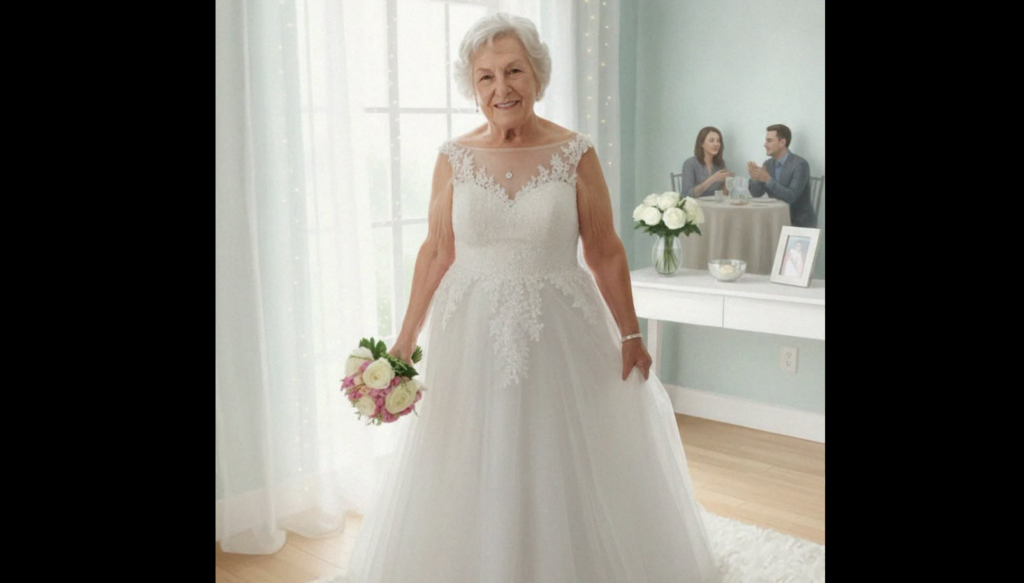
We got married in the hospital chapel in front of my children, two nurses, and Claire, who brought yellow roses. Thomas wore navy blue; I wore cream.
When I thanked Claire, she squeezed my hands.
For several weeks, Thomas and I were husband and wife.
“I hope that one day you will understand why I was afraid for you.”
“Tell me now.”
Her eyes filled with tears.
“Can’t”.
For several weeks, Thomas and I were husband and wife.
We shared breakfast, medicines, old songs, and meticulous plans.
One night, I caught him looking at photos of the house where I grew up.
He moved into my house, but he would disappear to meet with lawyers and contractors. When I asked him about it, he kissed me on the forehead.
“I’m finishing something important before time decides for me.”
I assumed he was referring to the medical paperwork or the arrangements for Claire.
One night, I caught him looking at photos of the house where I grew up.
The paint on the porch was peeling. Weeds covered the driveway.
Thomas ran a finger along the porch railing.
“There are places that are still waiting for people.”
“Where did you get them?”
He closed the folder.
“I’m just reminiscing about the old neighborhood.”
“That’s not an answer.”
“There are places that continue to wait for people, even when those people believe they have left everything behind.”
“Thomas”.
Two mornings later, his favorite show was still on TV when I found him in his armchair.
She smiled.
“Trust me.”
Two mornings later, his favorite show was still on TV when I found him in his armchair.
I called him by name twice before touching his shoulder, which was cold.
I knew his death was approaching, but knowing it did me no good.
The funeral passed in a whirlwind of hugs, kind words, and food that led to rooms where Thomas would never eat again.
The next morning, someone knocked loudly on my door.
Claire stood beside the coffin with swollen eyes.
He left before I could ask him about his warning.
The next morning, someone knocked on my door so loudly that our wedding photo was crooked.
Claire was out there, clutching a wooden box tightly.
“I tried to protect you. But you still fell right into their trap.”
“What are you talking about?”.
He handed me the box, but he didn’t dare let go of it.
“The burden he intended to leave you.”
I stared at her.
“Claire, what are you saying?”
He handed me the box, but he didn’t dare let go of it.
“Dad didn’t look for you all those years just because he missed you.”
I felt a knot in my chest.
Inside there were some keys.
“I had a plan, Ruth.”
“What’s the plan?”
Finally, he let go of the box.
“He spent almost everything to make sure that everything would be yours when he died.”
Inside were keys, property documents, trust papers, repair estimates, receipts, and photos.
I recognized the house instantly.
The house was intended to be sold to a property developer.
The house where I grew up.
“How did he achieve all this?”
Claire laughed bitterly.
“She bought it.”
The house was slated to be sold to a property developer. Thomas bought it before it was to be demolished, spending almost all his savings despite his medical bills.
“Was that the trap?”
The foundations were damaged, the roof was leaking, and the electrical installation needed to be replaced.
“Was that the trap?”
“Not quite”.
Claire took another folder out of the box.
“An obligation disguised as a gift.”
The sketches showed an accessible community house with reading rooms, a shared kitchen, gardens, and a space for workshops.
“He said that meeting you proved that people carry unfulfilled hopes with them into old age.”
Thomas wanted a place for elderly people who were rebuilding their lives after widowhood, illness, retirement, or estrangement.
Claire sat down opposite me.
“He said that meeting you had shown him that people carry unfulfilled hopes with them into old age.”
“That sounds very Thomas-like.”
“Yes of course”.
She dried her face.
Beneath the blueprints was a handwritten list titled “Things Ruth Should Decide.”
“I thought that restoring the house would give them back what they had both lost.”
“That’s not possible.”
“I know”.
He looked at me.
“Reality doesn’t work that simply, Ruth.”
Beneath the blueprints was a handwritten list titled “Things Ruth Should Decide.”
“So he let me choose.”
He had left all the decisions to me, from the rooms and gardens to whether or not to preserve the estate.
I looked at Claire.
“Didn’t he ask me to finish it?”
“The trust gives you control. You can terminate it, change it, or sell it all.”
“So he let me choose.”
Claire’s voice softened.
That was the burden she had feared.
“But he knew you would feel responsible.”
That was the burden she had feared.
Thomas had kept the past, but he hadn’t tried to claim my future.
I asked Claire to take me there.
“Today?”.
“Yeah”.
He resisted until I picked up the keys.
“You don’t have to decide anything yet.”
“I’m not going to decide anything. I’m just going to take a look.”
He resisted until I picked up the keys.
Then he nodded.
The house smelled of dust, damp wood, and old wallpaper glue.
Even so, I knew all the doors by heart.
Under the porch railing, I found our initials engraved inside a crooked heart.
I knew where my father was when he told me we were leaving.
Under the porch railing, I found our initials engraved inside a crooked heart.
T plus R.
The lines had faded over time, but they were still there.
Inside, they had already restored one of the rooms.
The small entrance hall, where Thomas and I used to study, looked almost the same as before.
“He always did this.”
The bookshelves and the fireplace had been restored, and next to some sharpened pencils were two library cards from 1963.
Claire sat down on the floor.
“He always did this.”
“That?”.
“He turned pain into a project.”
I sat down next to him.
“Finding you has brought back all the memories.”
“When Mom got sick, he researched all the treatments. After she died, he filled the back garden with roses because she had once said she would like to have them.”
“Not so many, I suppose.”
Claire smiled.
“No”.
Then his face darkened.
“I was afraid you would feel responsible.”
“Finding you brought back all the memories. He was trying to condense sixty years into the time he had left.”
“I understand”.
“I was afraid you would feel responsible when his dream became expensive, unfinished, and impossible to fulfill.”
“You were partly right.”
Claire looked at me.
“I can’t live here,” I said. “I can’t pretend the last sixty years never happened.”
Erasing those years would be an insult to the life she had lived.
I had my own home, my children, my marriage, my losses, and my identity.
Erasing those years would be an insult to the life she had lived.
“But I also don’t want this place to disappear.”
Claire glanced around the living room.
“What do you mean?”.
“I don’t know yet.”
We argued constantly.
During the following months, Claire and I reviewed the accounts, met with contractors, and partnered with a local organization that serves the elderly.
We argued constantly: she thought I idealized Thomas, while I thought she judged him too harshly. Neither of us was entirely wrong.
We reduced its design to a meeting room, a kitchen, a reading area and a garden managed by volunteers.
Claire took care of the repairs. I looked for donors, volunteers, and community partners.
While we were working, Claire told me about Evelyn.
“Mom and Dad were happy.”
“She didn’t spend her entire marriage wishing she were you.”
“Glad to hear it”.
“I need you to know that he didn’t spend his entire marriage wishing she was you.”
“I never thought about it.”
Claire stared at me.
“He loved her.”
“I know”.
Neither Evelyn nor Daniel had been a substitute.
“And Daniel?”
“I loved him very much.”
That answer seemed important.
Neither Evelyn nor Daniel had been a substitute.
Thomas and I hadn’t erased the lives that bound us together. We’d simply been given enough time to accept what had been taken from us.
On opening day, Claire found me under the porch, touching our old initials.
We call the place “Home Second Chapter”.
There, reading clubs, workshops, shared meals, and practical classes were held.
On one wall were photos contributed by visitors: not only first loves, but also spouses, children, friends, careers, homes, and all the lives they had lived before arriving.
On opening day, Claire found me under the porch , caressing our old initials.
He stopped beside me.
Claire offered me her arm.
“Would you like to be able to go back?”
I shook my head.
“No”.
She waited.
“I wonder what it would have been like to go on together.”
Claire offered me her arm.
This time, I accepted it.